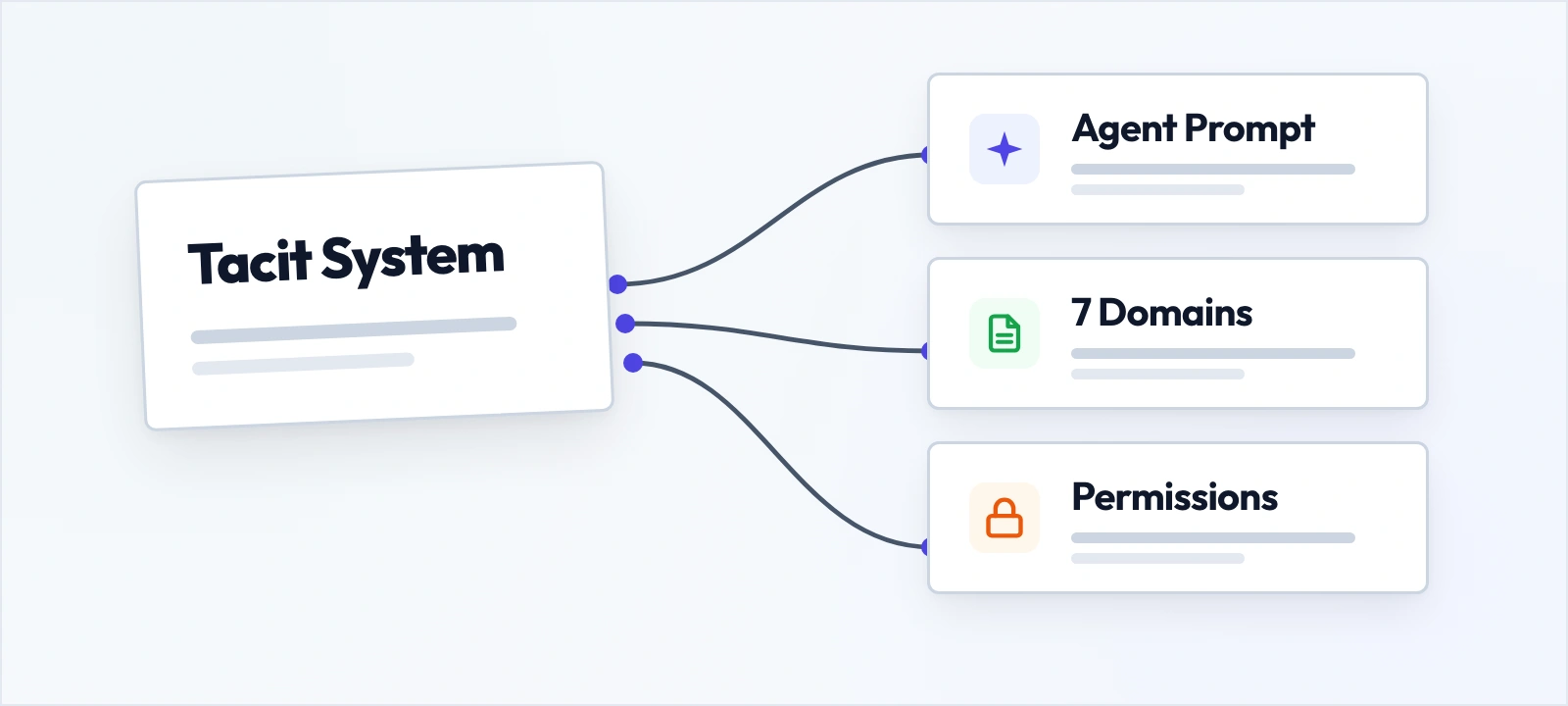
The 7 domains an AI-ready marketing knowledge system needs.
Context is not a dump of raw files. In practice, the knowledge required for recurring marketing work divides into seven distinct, retrievable decision domains.
Business & offer
Products, services, pricing, commercial terms, priorities, and explicit non-goals the business will not offer.
Customer & market
Segments, jobs to be done, customer vocabulary, triggers, objections, alternatives, and validated patterns.
Brand & voice
Message hierarchy, tone, approved/rejected examples with reasons, claims, and channel-specific boundaries.
Product & domain
Capabilities, tradeoffs, current roadmap, vendor claims vs observable behavior, and domain craft.
Operating rules
Workflows, handoffs, definitions of done, escalation paths, and publishing/spending approval boundaries.
Evidence & metrics
Source dates, metric definitions, experiment conditions, qualitative feedback, and confidence limits.
Decisions & learning
Rationale, changed assumptions, rejected directions, and approved lessons so the system compounds.
Data, information, knowledge, and guidance are not the same thing.
An agent can calculate data and summarize information. Turning it into permanent guidance requires human judgment, validated scope, and approved evidence.
| Knowledge Layer | Core Characteristic | Marketing Example (Paid Campaign) |
|---|---|---|
| Data | Raw observation or count | 120 form completions and a $38 cost per lead (CPL). |
| Information | Contextualized pattern with attribution | 70% of completions came from one broad-match campaign; sales accepted only 8 of 120 leads. |
| Knowledge | Evaluative insight against business goals | The campaign efficiently produced form fills, but the conversion optimized was not qualified demand. |
| Guidance | Approved rule for future recurring decisions | Evaluate performance against an agreed qualified-lead definition before changing targeting or bids. |
How tacit judgment becomes reusable guidance around the work.
Do not try to document everything first. Build the knowledge around one real recurring marketing task.
Define one recurring task
Start with one recognizable marketing job: diagnosing lead quality, briefing a campaign, or evaluating a tool.
Retrieve relevant scope
Fetch only the knowledge that can change this specific decision, rather than dumping all documentation.
Perform and capture traces
Let the agent draft, while recording human edits, overrides, and real decisions in the working context.
AI proposes candidate patterns
The agent compares traces of human judgment and proposes a candidate pattern or rule.
Human validates scope and limits
The marketer confirms, narrows, adds exceptions, or rejects the rule before it becomes guidance.
Compound future runs
Subsequent runs apply approved judgment, requiring less repeated explanation.
Most marketing teams don’t have a knowledge base—they have a folder
Most marketing teams don’t have a knowledge base. They have a folder.
It may contain a brand guide, customer research, campaign reports, content calendars, old presentations, prompt libraries, and dozens of documents nobody is quite sure are still current.
Giving an AI agent access to that folder feels like giving it context. But access to files is not the same as access to marketing knowledge.
The harder question is not how many files an agent can read. It is whether the agent knows how to use them: if an agent could read every file, would it actually understand how I make marketing decisions?
Not necessarily. It could find the audience document without knowing which audience matters for this task. It could read an old decision without knowing it had been superseded. It could retrieve a performance number without understanding the attribution problem behind it. It could imitate a published post without knowing which parts I would now change.
And it still could not access the most important layer directly: the judgment marketers build through experience but rarely write down. That is why an AI-ready marketing knowledge base cannot be just a documentation system. It needs to function as a decision system.
Marketing knowledge is contextualized, evidence-aware understanding that can change how a marketer decides or acts.
Amber Li · Founder, THE AI MKT
What turns information into marketing knowledge?
Marketing knowledge is not every fact, file, or metric a team possesses. Something becomes useful knowledge when it is connected to a recurring marketing decision or action, understandable in context, supported by evidence or a clearly identified source, and retrievable when the work needs it.
That distinction matters because data, information, knowledge, and guidance are not the same thing. An agent can help move from data to information and propose an interpretation. It should not silently turn that interpretation into permanent guidance. That requires evidence, scope, and human approval.
The seven domains an AI-ready marketing knowledge base needs
The right structure will vary by company. But in practice, the knowledge needed for recurring marketing work consistently falls into seven domains: Business and offer, Customer and market, Brand and communication, Product and domain, Operating knowledge, Evidence and performance, and Decisions and learning.
Without Business and offer, an agent can produce persuasive marketing for an offer that does not exist—or optimize for an outcome the business does not want. Without Customer evidence, generic personas lead to hallucinated pain points.
Similarly, a banned word list is helpful, but an edit history explaining why a technically correct sentence felt untrustworthy is often far more useful for training an agent’s voice.
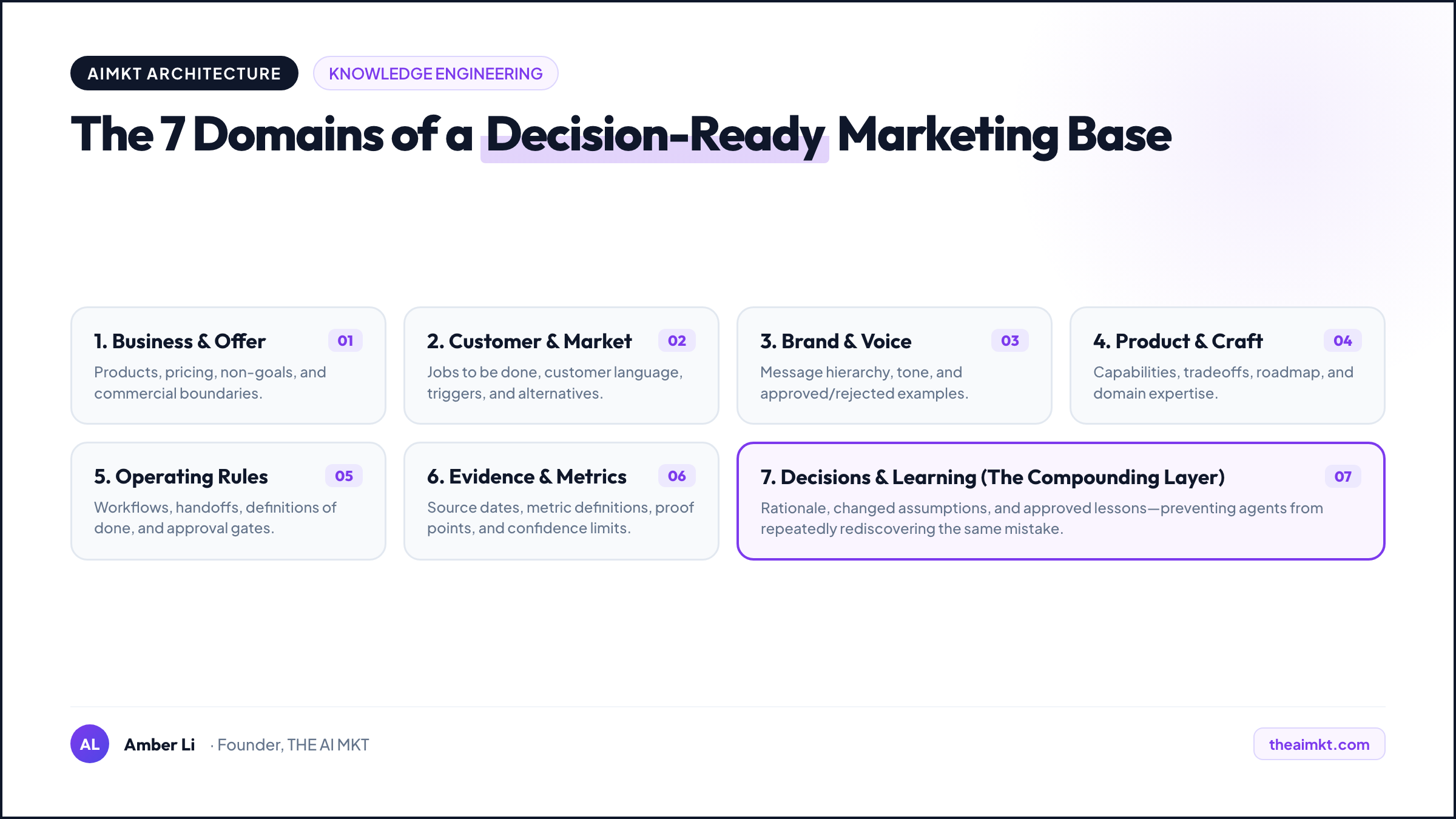
The seven domains ensure that an agent understands boundaries before generating copy. Review the AI Tool Review Prompt to see how these evaluation boundaries apply to software selection.
The hidden layer: Explicit, tacit, and emerging knowledge
The seven domains describe what the knowledge is about. But each domain contains three different knowledge states:
1. Explicit knowledge: has already been articulated and can be retrieved (e.g. an approved positioning rule with examples).
2. Tacit knowledge: exists in human experience but has not been adequately expressed (e.g. an experienced marketer sensing that a claim sounds untrustworthy without naming the exact signals).
3. Emerging knowledge: a possible pattern surfaced from new observations, edits, or results (e.g. several rejected drafts suggesting that abstract openings make a personal post feel impersonal).
AI cannot read tacit knowledge directly. But it can compare traces of human judgment—edits and their rationale, approved and rejected examples, exceptions, and overrides. From those traces, AI can propose a pattern. The marketer validates it, and only then does it become reusable guidance.
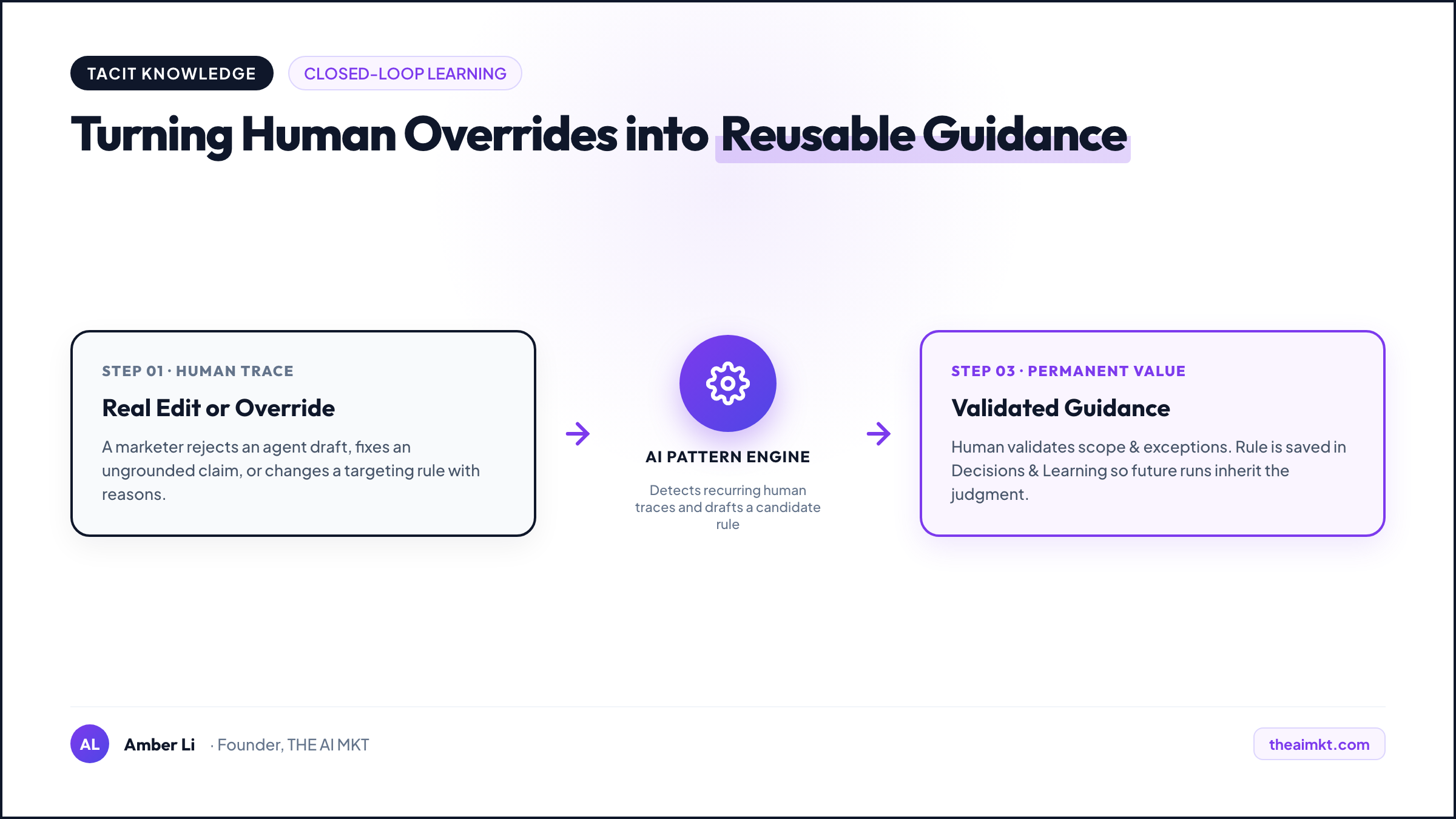
AI does not only automate execution. It helps make human experience inspectable and transferable—without pretending that all judgment can be reduced to a rule.
Operating Architecture
Knowledge should constrain an agent, not only inform it
Most discussions about AI context focus on helping the model produce a better answer. That is only one role of knowledge.
In a marketing system, knowledge should also tell the agent which sources to trust, what remains unknown, how success is defined, what it may do, and when it must stop for approval.
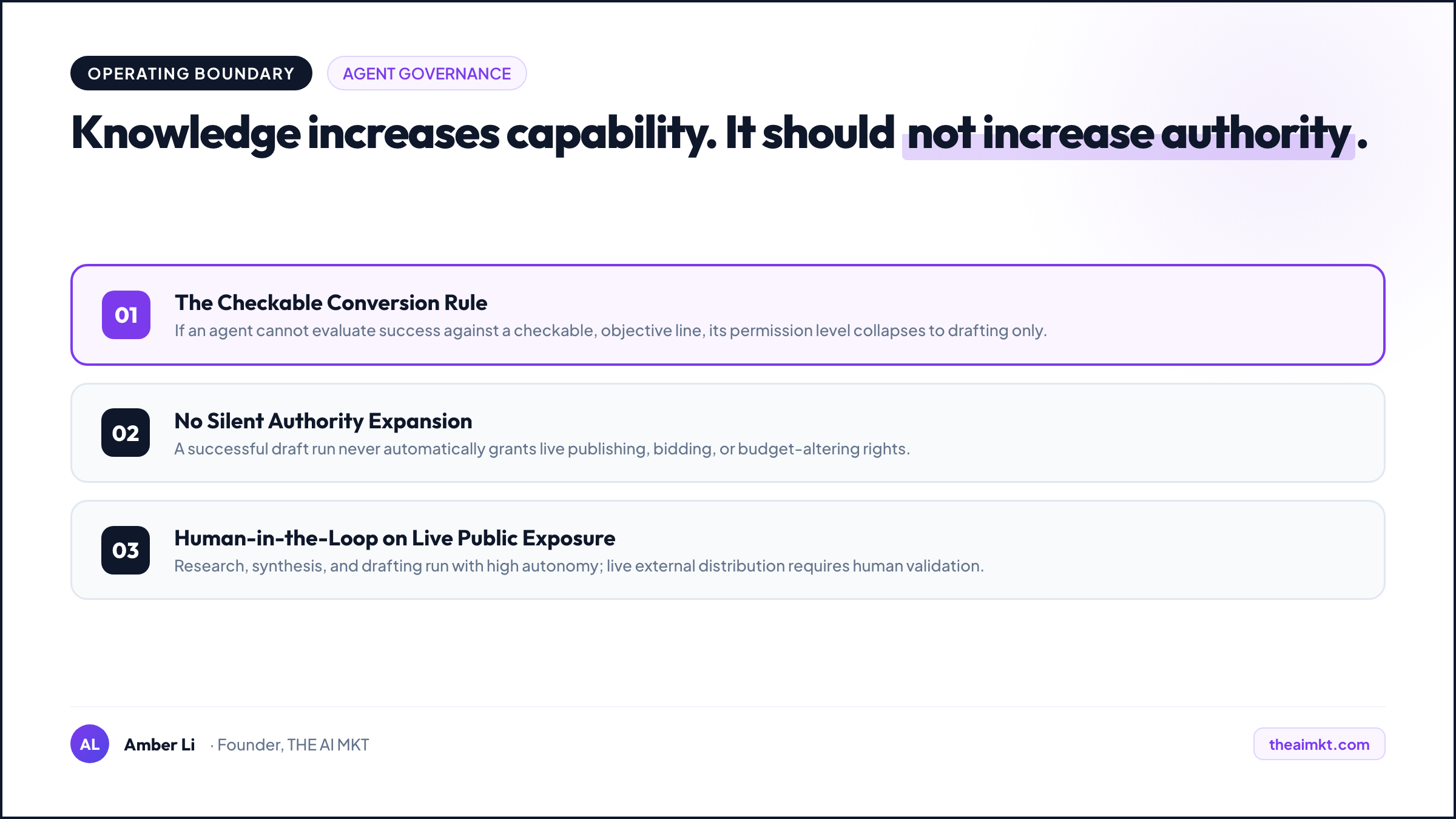
A key operating rule: if an agent cannot evaluate success against a checkable definition, its permission level should collapse to drafting.
More campaign history will not solve a missing conversion definition. It may only help the agent optimize the wrong loop more consistently. Until success is checkable, the agent should remain limited to research and drafting; live changes to budget, bids, creative, or public output still require human approval.
Knowledge increases capability. It should not silently increase authority.
Build knowledge around the work, not as a massive documentation project
The seven domains are not a checklist to complete before an agent can begin. A more useful starting point is one recurring marketing job: diagnosing lead quality, briefing a campaign, evaluating a tool, or deciding which content deserves an update.
The task determines which knowledge matters. The knowledge improves the work. The work then reveals what the system still does not understand.
Over time, the value of the knowledge base appears in the work itself: the agent requires less repeated explanation, avoids earlier misunderstandings, and applies approved judgment accurately.
The goal is not to create the biggest knowledge base. It is to make the smallest useful set of marketing knowledge available when a person or agent needs to make a better decision.
Put the framework to work: The open-source starter repo
This framework is packaged into the public AI Marketing Knowledge System Starter on GitHub, which can be used with agentic coding environments like Codex, Cursor, or Claude Code.
It provides the seven-domain structure, evidence and approval boundaries, task context, and a human-controlled learning loop—so you can begin with one marketing job instead of documenting everything first.
Clone the starter directly from GitHub: github.com/heyamberli/ai-marketing-knowledge-system. Open the folder with an agent, type "Start here", and describe one real recurring marketing task. The agent will build the working context around the job.