
Every marketing team and agency reaches the exact same breaking point around month three of running paid media: the reporting bottleneck.
You are running Meta Ads for top-of-funnel demand, Google Search for high-intent capture, LinkedIn Ads for B2B pipeline, Pinterest for lifestyle visual search, and now experimenting with ChatGPT Ads. Every Monday morning or month-end, someone on your team burns 4 to 8 hours:
- Logging into five separate ad managers across different currencies and attribution windows.
- Manually exporting CSVs into Google Sheets or wrestling with broken Looker Studio connectors.
- Pasting static numbers into Google Slides or Canva decks so an executive or client can look at a chart for thirty seconds.
Tools like DashThis (dashthis.com) were built over a decade ago to solve this exact headache. By offering 34+ native API connectors, pre-built templates, and automated PDF delivery, DashThis promised to eliminate reporting drudgery.
Yet as software design modernized and AI-assisted workflows exploded in 2026, DashThis's core web product began to feel like a digital time capsule. To stay relevant, DashThis recently launched two major product updates:
- AI Insights (PRO): A built-in side-panel feature promising automated monthly summaries, opportunity detection, and issue flagging.
- The DashThis MCP Connector: A beta Model Context Protocol integration allowing users to connect their live DashThis data sources directly to ChatGPT and Claude.
To evaluate whether DashThis is worth its $44–$164/month price tag—and whether its new AI capabilities represent genuine operational leverage or marketing vaporware—I conducted an unvarnished hands-on teardown.
1. The Real Setup & Inputs: Stress-Testing Multi-Channel Ad Data
Rather than connecting a single isolated account, I configured DashThis's full Advertising Strategy Template, which aggregates performance across five major paid acquisition channels:
- Meta Ads (Facebook Ads): Top-of-funnel retargeting and acquisition.
- Google Ads: Branded search, Generic search, and Performance Max.
- LinkedIn Ads: B2B Lead Gen Forms and Brand Awareness.
- Pinterest Ads: E-commerce visual discovery.
- ChatGPT Ads: Conversational sponsored placements.
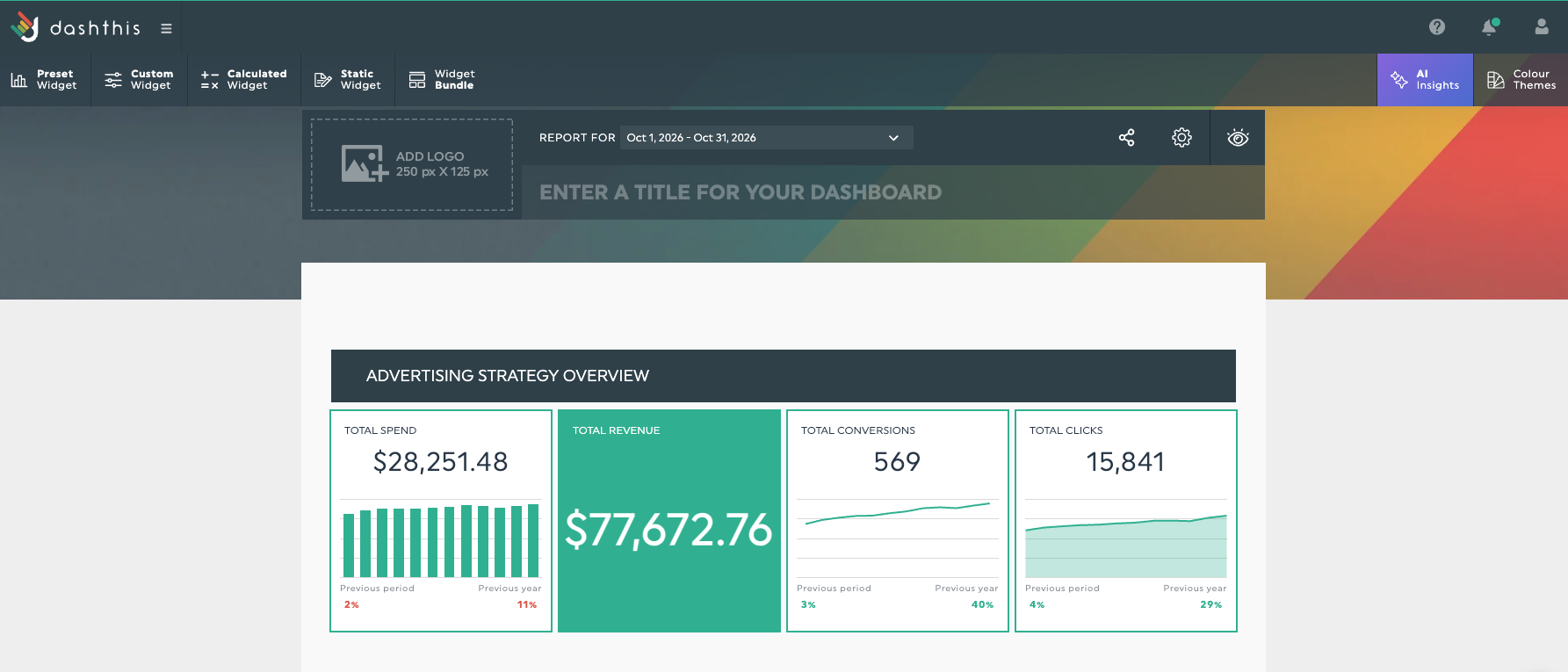
The dashboard was populated with standard monthly enterprise benchmark sample data:
- Total Ad Spend: $28,251.48 (+2% MoM, +11% YoY)
- Attributed Revenue: $77,672.76
- Total Conversions: 569.11 (+3% MoM, +40% YoY)
- Total Clicks: 15,841 (+4% MoM, +29% YoY)
Right from the initial header screen, the aesthetic tension of DashThis becomes immediately apparent:
The 2018 Skeuomorphic Hangover
While DashThis provides functional data aggregation, the UI aesthetics are jarringly out of step with modern design standards:
- The "Total Revenue" card is rendered in a blinding, full-bleed solid teal block (
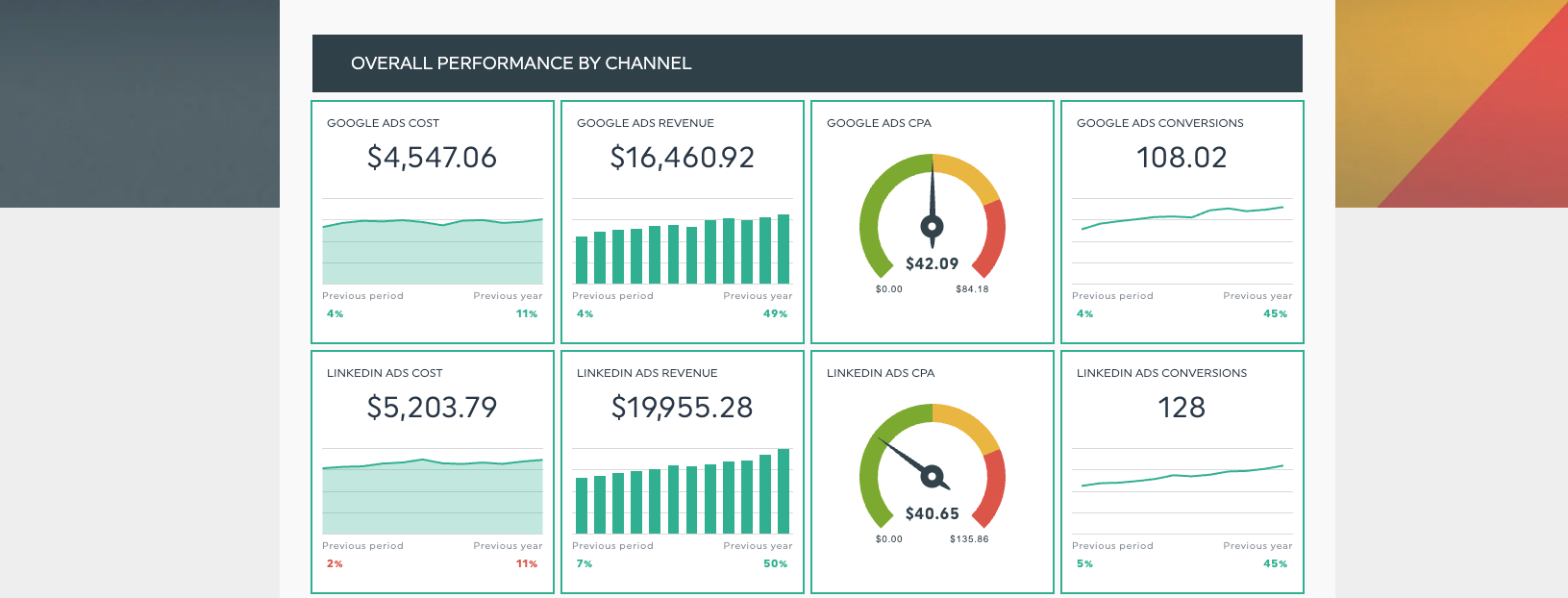
#1DB08E) that dominates the visual hierarchy for no discernible reason. - Channel-level Cost Per Acquisition (CPA) is represented by 1990s-style automotive speedometer gauges with green-yellow-red tachometer arcs. In 2026, watching a needle point at
$42.09on a gauge that arbitrarily caps at$84.18offers zero actionable information—it merely consumes valuable screen real estate. - Conversions are displayed with unnatural floating-point decimals (
108.02 Conversionson Google Ads,214.27 Purchaseson Meta Ads) without rounding or explanatory tooltips explaining attribution fractioning.
2. Testing the Built-in "AI Insights (PRO)": High Cost, Zero Insight, and Outright Hallucinations
DashThis includes a basic tier of its AI Insights feature (capped at 100 credits/month), but aggressively upsells users to AI Insights Pro—a paid add-on costing an extra $19/month ($15/mo billed annually) on top of the base $44–$164/mo subscription to unlock unlimited generations, chat mode, and custom business context. An eye-catching purple magic-wand button sits directly in the main navigation bar, offering a 7-day Pro trial. Clicking it opens a right-hand slide-out panel featuring four distinct tabs: Summary, Opportunities 🎯, Wins 🏆, and Issues ⚠️.
I clicked Summary and Opportunities to see what kind of strategic recommendations a dedicated reporting tool would provide to a marketing director.
The results were catastrophic.
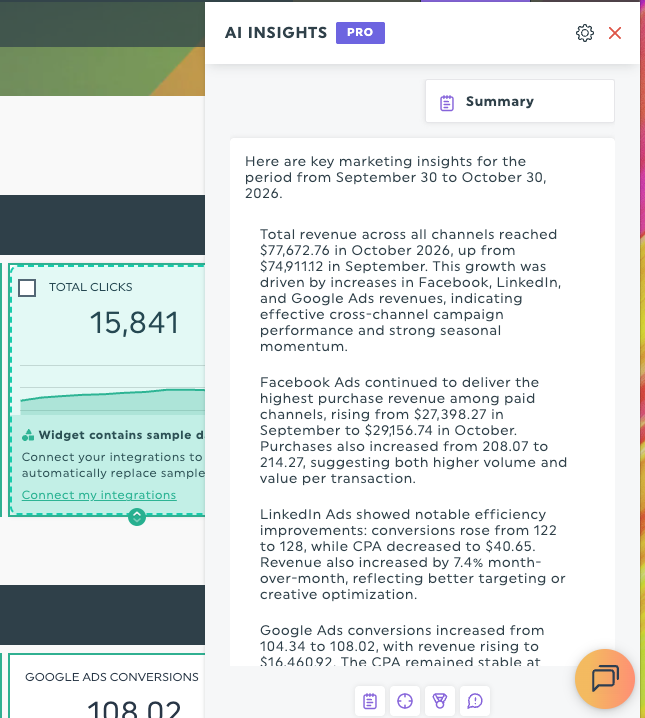
Redline Diff 1: The "Summary" Tab (A Glorified Screen Reader)
Here is the verbatim output generated by DashThis's built-in AI under the Summary tab:
The Redline Breakdown:
- Zero Synthesis: The AI did not calculate Blended ROAS, did not calculate overall blended CPA, and did not examine whether spend share matched revenue share.
- Pure Number Parroting: It simply took cell
B2and cellB3from the raw data table and wrapped them into an English sentence ("rising from X in September to Y in October"). Any human intern could read the exact same numbers off the screen in four seconds.
Redline Diff 2: The "Opportunities" Tab (Template Mad-Libs & Dangerous Hallucinations)
When I switched to the Opportunities 🎯 tab, the analysis degraded from lazy to dangerous.
Here is what DashThis's AI recommended for budget allocation:
The Operational Redlines:
- The Finite Budget Fallacy: The AI advised increasing investment in Facebook, LinkedIn, Google, Pinterest, and ChatGPT simultaneously. Marketing budgets are finite. A strategic advisor tells you where to cut spend in order to fund growth; a bad algorithm tells you to spend more money everywhere.
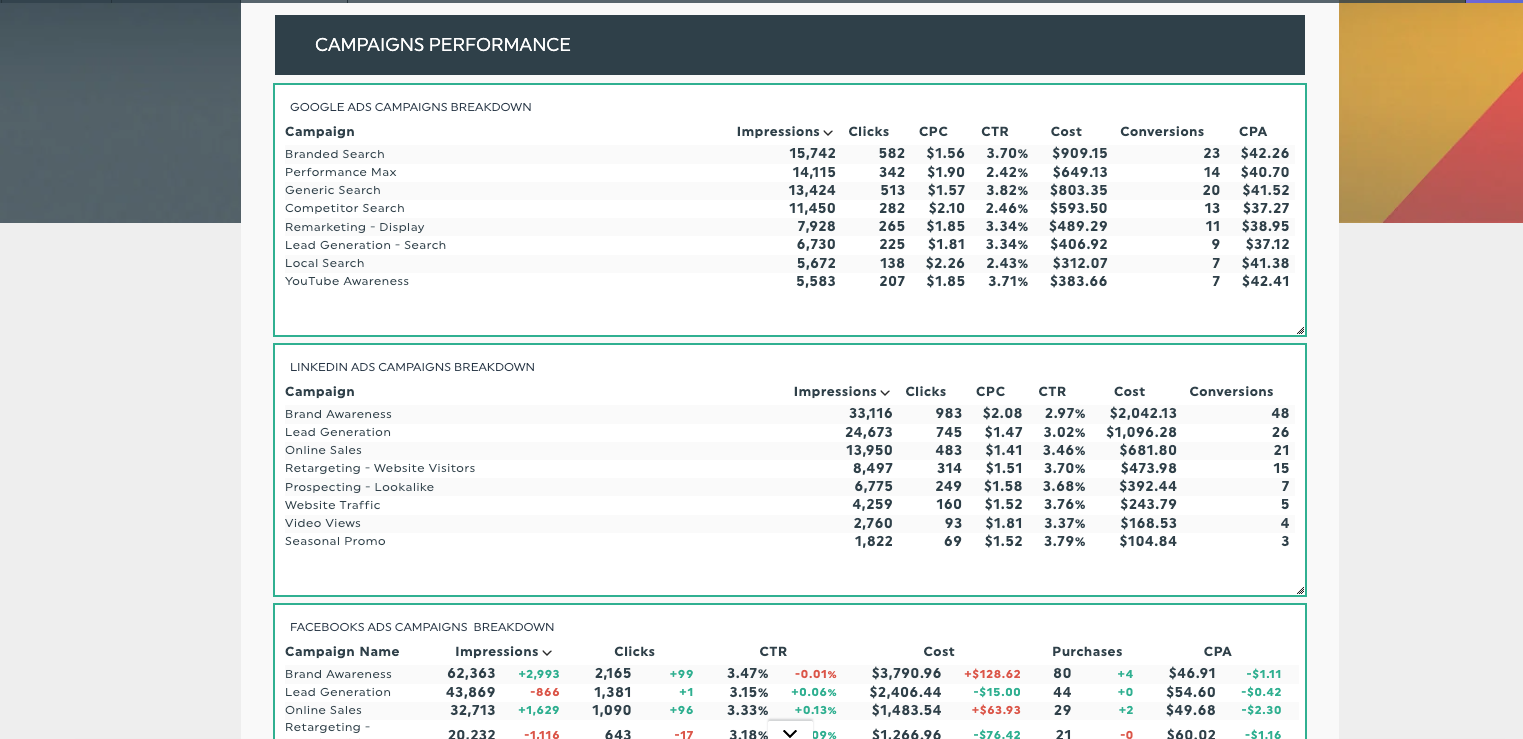
- The Ad Creative Hallucination: Look closely at the LinkedIn recommendation:
DashThis AI claimed: "consider increasing investment in top-performing creatives like 'Brand Video - 15s' and 'Lead Form - Carousel'..."
The Ground Truth: In the actual dashboard data (see Figure 4), the LinkedIn table only reports campaign names:Brand Awareness,Lead Generation,Online Sales,Retargeting - Website Visitors,Prospecting - Lookalike,Website Traffic,Video Views, andSeasonal Promo. There are no creative-level assets in the data whatsoever.
The built-in AI hallucinated'Brand Video - 15s'and'Lead Form - Carousel'out of thin air to make its generic mad-libs template sound specific. If an agency account manager pasted this into a client report, the client would immediately ask where those ads were running—and discover the agency was using a hallucinating bot.
3. The Breakthrough: DashThis via Model Context Protocol (MCP)
After experiencing the dated web UI and the broken built-in AI, I connected DashThis's new MCP Connector (dashthis.com/mcp).
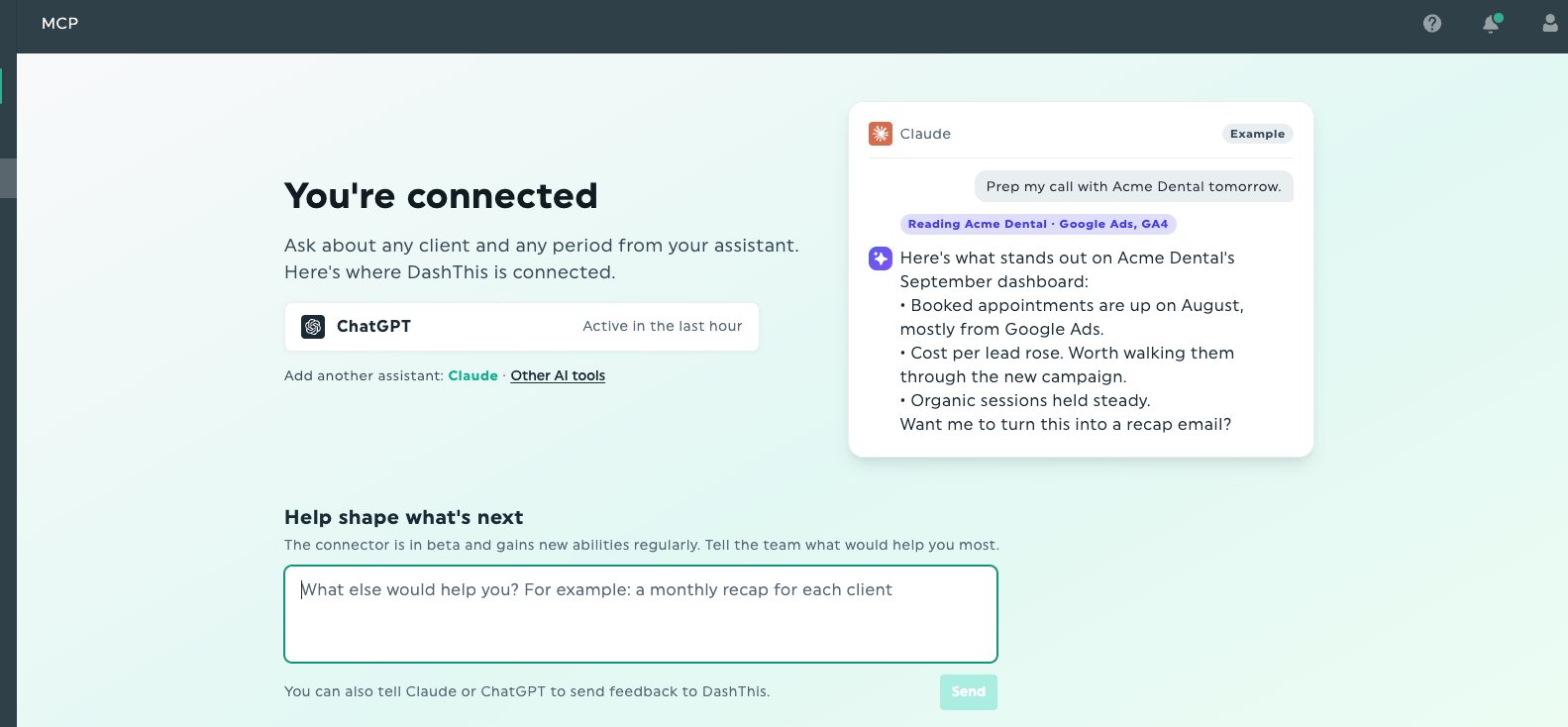
The Model Context Protocol (MCP) is an open standard that allows frontier LLMs (like Claude and ChatGPT) to read structured data directly from external software tools via secure local or cloud connections.
Instead of looking at DashThis's web frontend, I opened ChatGPT Canvas with the DashThis connector enabled and submitted a single prompt:
In exactly 35 seconds, ChatGPT ingested the full multi-channel JSON payload from DashThis and rendered an interactive, beautifully structured strategic review.
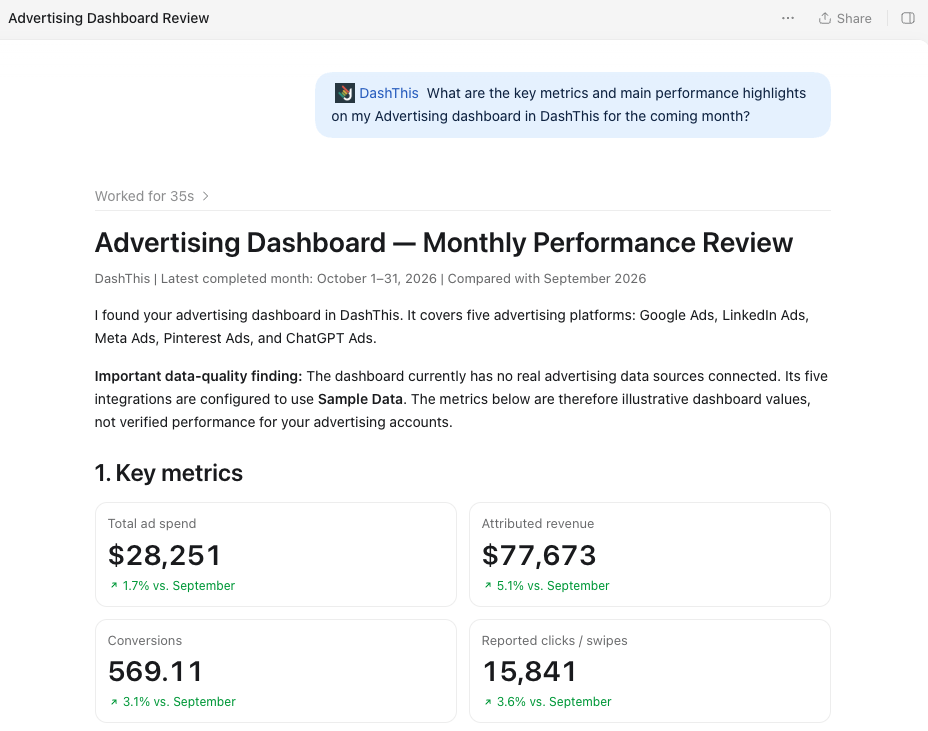
The contrast between DashThis's native web app and the generative MCP interface was startling:
1. Data Integrity Honesty Over Cosmetic Vanity
While DashThis's web dashboard attempted to disguise the sample data under miniature grey badges, ChatGPT's very first section led with a prominent, unambiguous operational disclaimer:
This is the hallmark of high-trust reporting: before telling leadership how great the numbers look, verify whether the data pipe is real.
2. Modern Generative UI Architecture
ChatGPT discarded DashThis's harsh solid-teal containers and archaic speedometer dials. In their place, it rendered a clean 4-card executive scorecard:
- Total Ad Spend:
$28,251(↗ 1.7% vs. September) - Attributed Revenue:
$77,673(↗ 5.1% vs. September) - Conversions:
569.11(↗ 3.1% vs. September) - Reported Clicks / Swipes:
15,841(↗ 3.6% vs. September)
Each card featured 12px rounded corners, neutral card borders, crisp typography hierarchy, and subtle green trajectory arrows. It looked like a $50,000 custom internal dashboard built in Next.js and Tailwind, delivered on demand in 35 seconds.
3. Derived Business Intelligence (Blended ROAS)
DashThis's own KPI widget failed to calculate the single most important metric for an executive: Return on Ad Spend (ROAS).
ChatGPT immediately computed the missing ratio from the raw totals:
4. Cross-Channel Diagnostic Table & Catching the Tracking Blind Spot
ChatGPT condensed the messy multi-page dashboard into a unified executive decision matrix:
| Channel | October Spend | Spend Change | Revenue Change | Key Efficiency Signal |
|---|---|---|---|---|
| Google Ads | $4,547 | +4.2% | +4.2% | CPA worsened 0.6% |
| LinkedIn Ads | $5,204 | +2.2% | +7.4% | CPA improved 2.5% |
| Meta Ads | $10,790 | +0.8% | +6.4% | CPA improved 2.1% |
| Pinterest Ads | $2,834 | −1.9% | −0.2% | Conversions up 1.1% |
| ChatGPT Ads | $4,877 | +3.2% | Not tracked | CPC improved 1.4% |
Notice the critical observation in the fifth row: ChatGPT Ads has a measurement gap.
While DashThis's built-in AI blindly told the user that ChatGPT Ads was a "top performer" based on cheap clicks ($1.72 CPC), ChatGPT's LLM caught the operational flaw:
5. The Attribution & Double-Counting Warning
The crowning difference between DashThis's native feature and MCP was this critical warning inserted by ChatGPT:
In modern paid media, Meta and Google routinely claim credit for the exact same conversion. DashThis's native interface simply adds $16,460 + $19,955 + $29,156 = $77,672 without warning the user. ChatGPT actively cautioned the operator against taking platform-reported revenue at face value.
4. Cognitive Limits & Failure Modes
To maintain editorial honesty, operators must recognize the distinct failure modes of both approaches:
DashThis Web & Built-in AI Failure Modes
- Inflexible Dashboard Tiers: DashThis prices by dashboard count ($44/mo for 3, then jumping straight to $139/mo annual / $164/mo monthly for 10). If you have 4 clients or brands, you are forced onto the 10-dashboard plan, paying for 6 empty slots every month.
- Reseller AI Syndrome: The built-in
AI Insights (PRO)feature appears to be a naive prompt-wrapped API call with low context injection. It hallucinates creative-level assets, gives identical boilerplate advice across unrelated channels, and fails basic budget-allocation logic. - Static Visuals: You cannot ask DashThis's web interface to filter out branded search, combine lookalike audiences, or normalize currency conversions on the fly. You must manually drag widgets, edit formulas, and re-save layouts.
DashThis MCP Connector Limitations
- Strictly Read-Only (Current Beta): The MCP connector allows ChatGPT and Claude to query and analyze dashboard data, but it cannot write back to DashThis. You cannot instruct ChatGPT: "Take this table and replace the speedometer gauge on my live dashboard with it."
- Context Window Boundaries: While a 5-channel summary consumes negligible tokens, an enterprise account with 200 ad sets and 500 creative variations will quickly push frontier LLMs toward context limits or token rate throttling.
- Prompt Dependence: The quality of output through MCP depends entirely on the operator's prompt. If you ask a vague question ("How are my ads?"), ChatGPT will provide a vague answer. You must instruct it to evaluate ROAS, check attribution windows, and recommend budget reallocations.
5. Operational Verdict & Buy/Skip Matrix
DashThis presents one of the most fascinating paradoxes in B2B SaaS: its proprietary frontend is rapidly becoming obsolete, yet its data connectors are more valuable than ever.
| Decision Trigger | Recommended Action | Operating Rationale |
|---|---|---|
| Turnkey MCP Pipeline for LLMs | BUY DASHTHIS ($44–$139/mo) | You want a zero-maintenance data pipe into ChatGPT/Claude via MCP without configuring BigQuery, Funnel, or custom API scripts. |
| Traditional Agency Client PDF Reports | BUY DASHTHIS ($44–$139/mo) | You run an agency whose clients demand scheduled, branded PDF reports delivered to their inboxes on the 1st of every month. |
| Modern Interactive Client Portals | SKIP DASHTHIS | DashThis's web UI feels dated. Choose AgencyAnalytics for client portals or Triple Whale for first-party DTC attribution. |
| Buying for Built-in "AI Insights Pro" ($19/mo Add-On) | SKIP DASHTHIS | The built-in AI is a generic text repeater prone to hallucination and creative fabulation. Save the $19/mo and use ChatGPT or Claude via MCP instead. |
| Solo Consultant with 1 Brand | SKIP DASHTHIS | The minimum tier is $54/mo (for 3 dashboard slots). If you only run 1 brand, 2 slots sit idle, making it a poor capital fit. |
The Bottom Line
- Do not buy DashThis for its built-in AI: The
AI Insights (PRO)add-on is a generic text repeater prone to hallucination. - Do buy DashThis if you want to bypass manual data engineering: Connecting Meta, Google, LinkedIn, Pinterest, and GA4 to ChatGPT via DashThis MCP gives you an automated, multi-channel marketing analyst for $44 to $139/month. You get the data plumbing of an enterprise ETL tool with the reasoning power of frontier models—and you never have to look at an automotive speedometer gauge again.