
For product marketing managers (PMMs), the biggest headache when evaluating software isn’t a shortage of tools—it’s that the cost of testing and subscribing is often completely out of touch with reality.
If you need a dedicated competitive intelligence (CI) and battlecard stack, the industry standards (like Crayon or Klue) are built almost exclusively for enterprise budgets: $15,000 to $30,000 annual contracts, zero public self-serve trials, and mandatory discovery calls just to see a dashboard. The barrier to simply try them is enormous.
On the other extreme, you have the DIY route: copy-pasting competitor homepages into ChatGPT or Notion. It’s free, but the cognitive maintenance debt is brutal. Two busy launch weeks go by without manual updates, and your positioning documents and battlecards suffer irreversible “asset drift.”
Solo PMMs, founding marketers, and lean teams are trapped in this gap: Can we actually get a structured, living GTM foundation running without signing a five-figure enterprise contract?
That dilemma is why I decided to test Calven (calven.ai)—a newly launched platform offering a 14-day card-free trial and pricing starting at $99/month, explicitly designed to automate competitive tracking, ICP definition, and positioning for lean B2B teams. Rather than reading their marketing claims, I plugged my own live site (theaimkt.com) directly into their onboarding engine.
Here is what actually happened.
The First Look: A Canvas That Replaces the Blank Prompt
Most generative AI tools today still rely on the same lazy interface: an empty text box asking, "What do you want to write today?" That model fails product marketers because strategic assets can't be created in a vacuum—every deliverable requires re-prompting context from scratch.
Calven took a noticeably different architectural path. When I entered my domain, it didn’t open a chat window. It mapped the business into a centralized Knowledge Graph Canvas, radiating outward into the core pillars of product marketing:
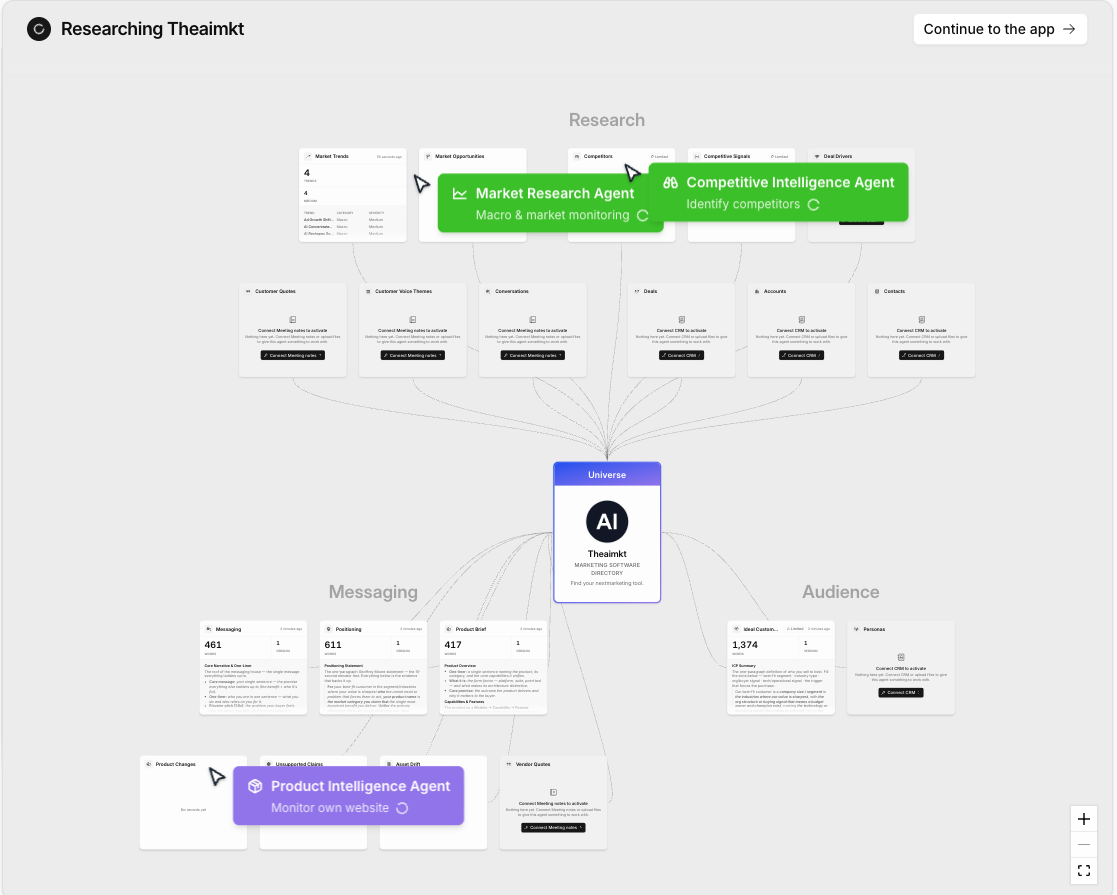
The structure mirrors the classic discipline of product marketing:
- Research (Inputs): Market trends, competitor moves, voice of customer, and win/loss signals.
- Audience (Targeting): ICP boundaries and functional buyer personas.
- Messaging (Outputs): Core narrative, positioning frameworks, and sales battlecards.
What makes this structure work in practice is how Calven handles changes. Instead of autonomously rewriting your company messaging (which would be catastrophic for any brand), Calven’s background agents asynchronously crawl the web, parse competitor shifts, and queue proposals into an Approval Inbox:
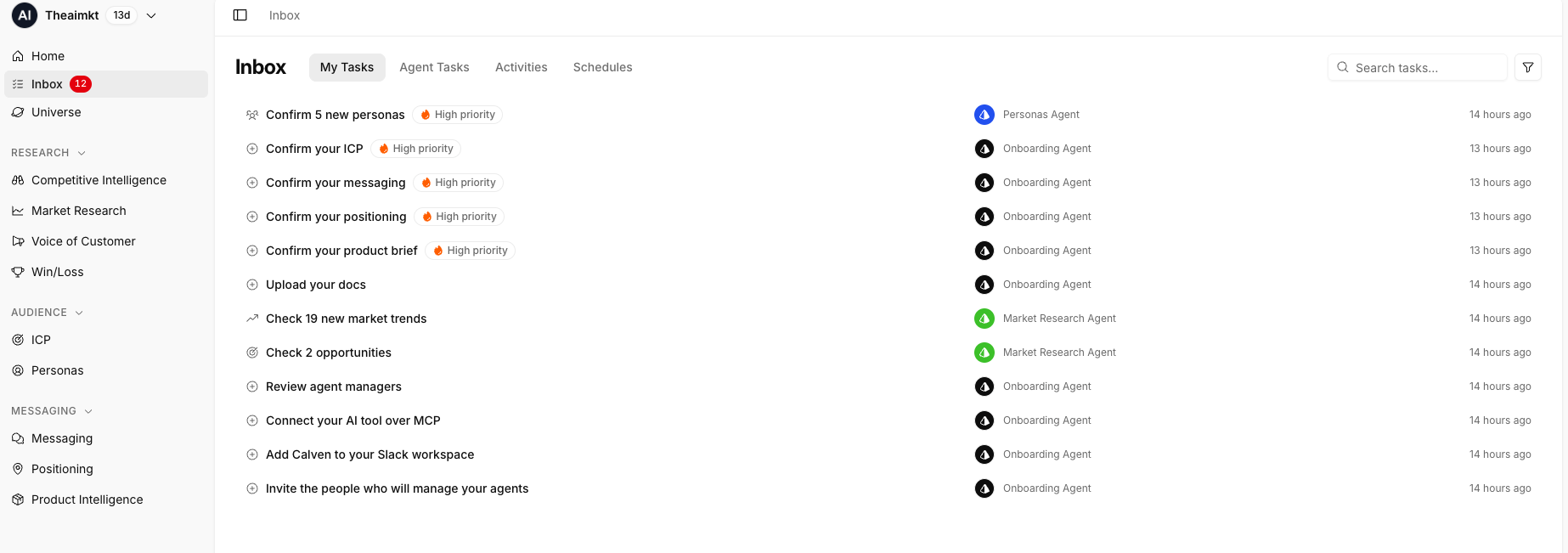
For an overwhelmed practitioner, this shift in interaction model matters. Turning the daunting task of drafting strategy into a zero-inbox review workflow removes 80% of the friction. You aren’t staring at a blank Google Doc; you’re reviewing, editing, and clicking Approve.
Testing the Outputs: Where Methodological Rigor Meets a Solid 75% Baseline
A sleek interface is a good first impression, but it means nothing if the underlying intelligence defaults to generic AI fluff. To see if Calven had actual domain depth, I opened the approval queue for theaimkt.com to inspect its core deliverables.
What immediately stood out was the platform's methodological rigor. Instead of treating GTM strategy like creative writing, its output follows disciplined B2B taxonomies:
- Role-Specific Persona Typing: Most AI prompts mush personas into an unrealistic composite archetype. Calven explicitly differentiates roles: The User (daily execution friction), The Buyer (budget, ROI, payback period), and The Stakeholder (governance, veto power).
- Multi-Dimensional ICP Architecture: Rather than stopping at basic company size, it systematically organizes targets into firmographics (ARR, headcount tiers), technographics (tooling debt and AI adoption), and behavioral catalysts (the exact operational friction triggering a software search this quarter).
- Structured Positioning: It mapped our core value proposition directly into the classic Geoffrey Moore framework (target customer, category definition, core benefit, and reference alternatives).
Stress-Testing the Messaging Agent: Before vs. After
Downstream on the canvas, Messaging isn't an isolated copywriting tool; it is tethered directly to those Audience and Research nodes. But how does it handle subjective voice and tone?
Its initial draft for theaimkt.com was factually accurate, but predictably safe and corporate:
- Initial Core Message: "For marketers choosing their next tool, AIMKT helps turn a real workflow question into a more informed decision with independent shortlists, practical comparisons, and clear-eyed trade-offs—not another feature list."
- Initial One-Liner: "AIMKT is an independent research and discovery desk that helps marketers find and compare tools for the work they need to get done."
It sounded like a legacy Gartner whitepaper. So I pushed back: I prompted the Messaging Agent to drop the polite corporate tone, cut the passive filler, and adopt a punchy, practitioner-first voice that takes a clear stand against thin AI wrappers.
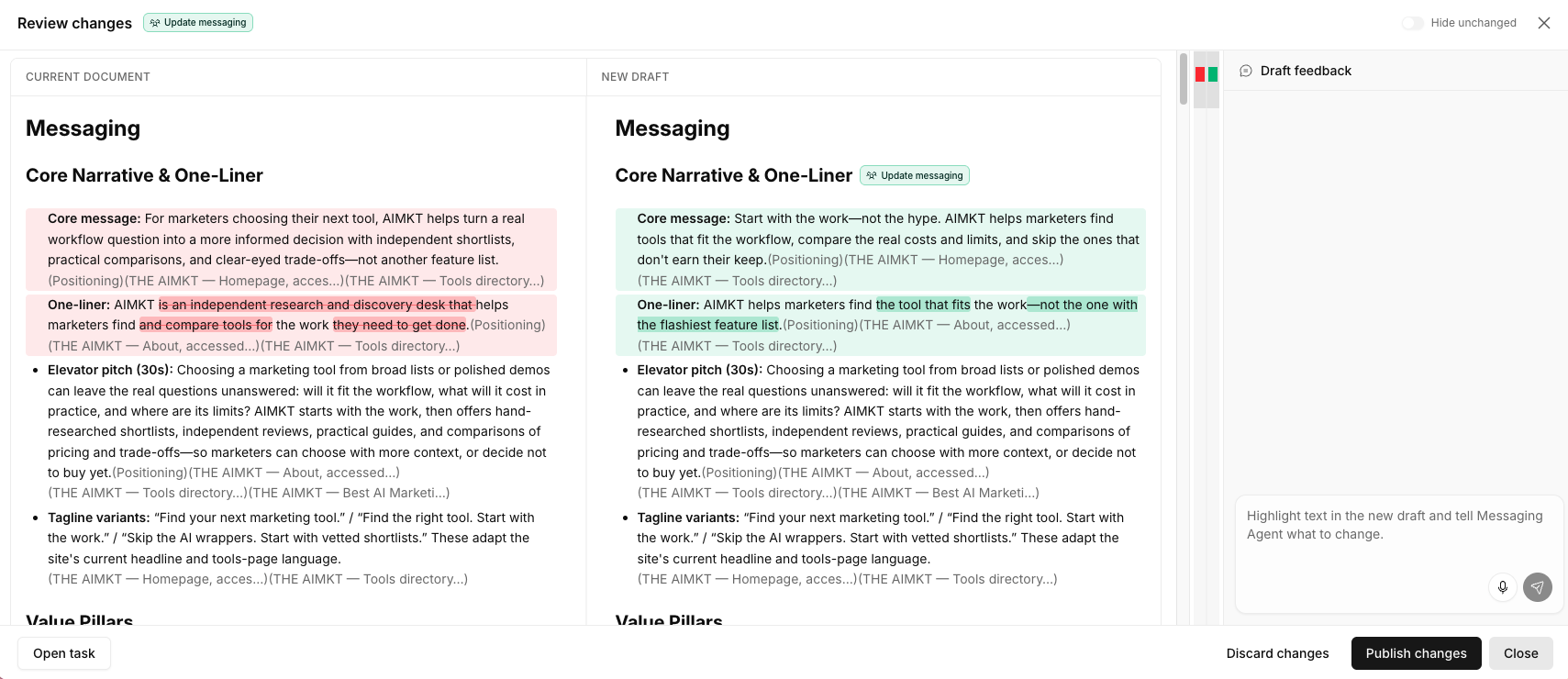
Instead of dumping raw text back into an unformatted chat bubble, Calven generated an interactive visual Diff Review:
The Revised Output:
- Core Message:
- Before: "...helps turn a real workflow question into a more informed decision..."
- After: "Start with the work—not the hype. AIMKT helps marketers find tools that fit the workflow, compare the real costs and limits, and skip the ones that don't earn their keep."
- One-Liner:
- Before: "AIMKT is an independent research and discovery desk that helps marketers find and compare tools..."
- After: "AIMKT helps marketers find the tool that fits the work—not the one with the flashiest feature list."
The revised copy isn't Shakespeare—it’s what I’d call "solid, competent B2B copy" (an 80% baseline). But more importantly, the interaction ergonomics—reviewing changes in a Git-style redline diff with 1-click publishing rather than hunting through chat transcripts—is how AI software for serious teams should actually behave.
The Missing Muscle: Strategy vs. Execution
Yet, about two hours into working inside this structured universe, an uncomfortable reality began to sink in—one that every practitioner testing this platform will inevitably run into:
"The canvas is neat, and the ICP is 1,300 words. But who is actually building my Webflow landing page, creating the product tour, and drafting the five customer emails due at 3 PM today?"
This is where you collide with the central reality of Calven: it provides zero native execution.
There is no landing page builder, no email sequence scheduler, no graphic studio, and no rich-text blog CMS. Inside Calven’s interface, you cannot press a button to generate a Figma deck or publish an announcement.
To evaluate this fairly, you have to look at the great divide across the entire marketing software landscape:
- The Strategic Intelligence Camp (Klue, Crayon, Calven): They sit in the boardroom and sales meetings, defining the Who, What, and Why (battlecards, ICP, positioning). But their execution capability is zero. Even an enterprise giant like Klue ($25,000/year) won't write your product launch blog post.
- The Generative Content Camp (Jasper, Copy.ai, Writer, Canva): They live in the execution trenches, churning out collateral at scale. But their strategic depth is wafer-thin. Uploading a static PDF "Brand Voice" doc doesn't prevent them from hallucinating generic copy when given shallow prompts.
Calven’s Architectural Gamble: Strategy in Calven, Execution in Claude
Calven made an explicit architectural bet: it refuses to be an asset studio.
Instead of building a mediocre in-house email writer or Canva clone, Calven aims to be the single source of truth—the "Approved GTM Universe." Its operating thesis is:
Strategy lives in Calven; execution is outsourced to your external AI tools via MCP.
"We have no plans to build features that create the final asset (like landing page or email builders), and we don't think they will be needed," explains David Kolínek, Co-founder & CEO of Calven, when I pressed him on this missing execution layer. "We built Calven headless from day one, and that includes our power users. A PMM reviewing Calven's suggestions can resolve them in Slack, or in Claude or ChatGPT through MCP, without opening the app. Final assets work the same way. People will create them in their AI tools with their own company skills—for example, a presentation skill that keeps every battle card deck on brand.
Design tools are moving the same way: Figma Make already lets you connect third-party MCP servers like Calven's, so when you ask it for a landing page, it pulls the product messaging straight from Calven. Canva and the CMS platforms will follow. Headless work is only starting: today just a handful of people really know how to use it. As MCP and CLI adoption grows, demand for asset creation inside tools like ours will shrink, and people will simply stop expecting it. Our job is to provide context that is accurate, current, and verified, wherever the work happens."
Calven natively implements a remote Model Context Protocol (MCP) server (https://api.calven.ai/mcp), exposing its strategic repository to Claude, ChatGPT, Cursor, and custom agent workflows. A closer look at its MCP architecture reveals a remarkably disciplined division of labor:
- What MCP Can Do: Headless Generation & Persona Reviews
From your own local IDE, terminal, or Claude chat, an agent can call tools likeget_strategy_document(messaging),get_persona, andlist_records(quotes)to ground drafts in verified company facts. More impressively, it exposes an active agent review hook:review_against_personas. You can draft a landing page or launch email locally, pass it through MCP, and have Calven’s background agents simulate buyer feedback—flagging lines that an economic buyer or technical stakeholder wouldn't believe—without ever logging intoapp.calven.ai. - What MCP Cannot Do: A Strict Read-Only Guardrail
Crucially, Calven's MCP server is strictly read-only: "The server is read-only: it writes, sends and publishes nothing." You cannot remotely rewrite or publish updates to the company’s master Universe from Claude or Cursor. Master changes (like the Redline Diff we stress-tested earlier) must be explicitly signed off by a human in the Web UI or via Slack. This intentional constraint protects brand integrity—preventing a casual prompt session in Claude from silently corrupting the official go-to-market source of truth.
The Practitioner Reality:
This is a sophisticated, forward-looking architecture for AI-native teams. If you know how to connect an MCP endpoint, Calven functions as an invisible, self-updating strategic co-pilot running silently behind your daily workflow. But for a solo marketer who doesn't use MCP, the experience can feel like an unfinished loop: you get a brilliant strategic brain, but no limbs to do the dirty work.
The Buyer’s Ledger: Trade-offs, Math, and Verdict
Once you view Calven through this lens—as a headless strategic brain rather than an all-in-one marketing suite—the purchasing decision suddenly becomes clear.
Before entering credit card details, buyers must weigh two practical trade-offs:
- The AI Workflow Maturity Prerequisite: If your team isn't already comfortable using Claude, ChatGPT, or Cursor with custom MCP connectors, you will feel Calven’s lack of in-app execution acutely. It is a strategic database, not an execution suite.
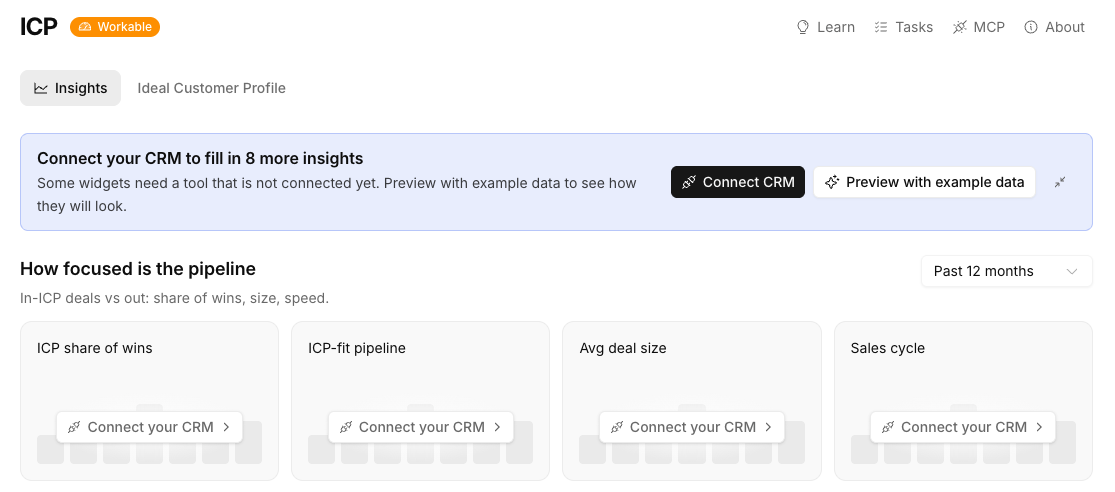
- The Integration Threshold: Public web crawling provides an excellent kickstart, but the real enterprise power lives in connecting internal data: CRM pipeline notes (HubSpot/Salesforce) and sales call recordings (Gong/Zoom). Without those, you capture external competitor moves, but miss internal deal dynamics.
The Math: Is It Worth $99/mo?
- Who Should Buy:
- Solo PMMs & Founding Marketers: If you are overwhelmed trying to maintain battlecards, ICP definitions, and messaging consistency across a growing team, paying $99/mo to have an automated, self-updating strategic foundation is an easy ROI win.
- AI-First Teams Using Claude or Cursor: If your team already uses AI tools daily, plugging Calven’s MCP server in as your verified "GTM brain" instantly eliminates prompt hallucinations and asset drift.
- Teams Seeking an Alternative to $20k Enterprise Lock-in: If you need disciplined competitor tracking and battlecards without signing a multi-year contract with Crayon or Klue, Calven is currently the most accessible self-serve option on the market.
- Who Should Wait or Stay Manual:
- Teams Needing an Execution Factory: If you are looking for an AI tool to directly generate social graphics, build landing pages, or send automated email blasts, Calven will leave you empty-handed.
- Passive Buyers: The platform requires a human pilot to triage the Approval Inbox. If you don't spend 5 minutes a week reviewing agent proposals, your Universe will stall.
 Amber Li · Practitioner Question
“If a marketer can already upload their company context into a free Claude Project or Notion AI to draft positioning, why should they pay $99/mo for Calven?”

Verdict
Calven is not a silver bullet, but it represents one of the most intellectually honest products in the PMM space. Rather than pretending an AI can magically run your entire marketing department, it draws a strict line between Strategy (what it organizes and protects) and Execution (what you and your external tools build).
By combining a Knowledge Graph Canvas, a Git-style approval inbox, and an open MCP architecture for $99/month, Calven provides lean teams with an accessible, disciplined strategic anchor.
Just know what you're buying: you're hiring a meticulous strategic brain, not a pair of hands to do the typing.